Last month, we looked at why you might want to write prolifically and how to start thinking about time management.
Having multiple projects going simultaneously keeps your writing and creative juices flowing, helping you avoid boredom, burnout, and writer’s block. Whenever one of those killer B’s hits you on one project, just turn to the next—Plan B!
The technique has allowed me to stay engaged and respond in real-time to fast-moving issues in the world. When you’re writing on intelligence, national security, international terrorism, politics, and propaganda, being a few hours out of date relegates you to the dustbin of history. If you’re trying to make a difference, you have to make the difference now. You have to choose whether you’re involved in making history or merely writing about it later.
This method works for me for non-fiction. I recently listened to a prolific local author—she generates a book every six weeks—who writes fiction seriatim, not consecutively. Her reasoning is that you don’t have to “reload” your brain every time you return to the book. You can remember continuity issues better if you’re working on the same thing and let it consume your time.
She also argues, by the way, that if you’re strictly in it for the money, just focus on that goal. Put out the product in areas where people are buying. Romance, erotica, mystery, thrillers sell. Literary masterpieces do not. Historical fiction is tough to write quickly. Make it easy to read. Make it 65-85K words. Use dialog and white space. Do the intellectual heavy lifting for your audience—don’t make them struggle to follow you. Don’t use $5 words when dime-a-dozen words will do. Write a book series—if they liked your character in this novel, they’ll want to find out what happens next to him/her. Write in the form of e-books.
In addition to these long-term goals, have short-term, including daily, ones. I average about 800 words/day. By the end of the year, I’ve generated about 300K words. For a novelist, that’s around five shortish novels. For my longer nonfiction books, that’s a long book per year, plus a few articles.
Hitting these goals take time, and you have to balance getting to those goals with what you’re willing to not do to get to them.
You don’t have to sacrifice everything, however. You can use time management and tracking techniques, such as my spreadsheet, which we’ll examine next month.
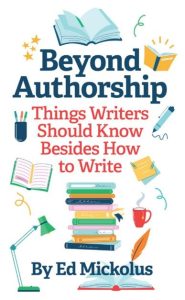 Unlock the secrets to writing success with “Beyond Authorship: Things Writers Should Know Besides How to Write.”

Mickolus, a prolific author and retired CIA officer, Beyond Authorship is a must-read for aspiring and seasoned writers alike. This comprehensive guide goes beyond the craft of writing to explore the essential skills and knowledge every writer needs to succeed in the competitive world of publishing.
From generating creative ideas to navigating the publishing process, Mickolus shares practical tips, techniques, and insider advice drawn from his extensive experience writing more than 60 books and hundreds of articles.